



Dutch Mountain
The Company has acquired a 100% interest in the Dutch Mountain Processing Facility, a strategic industrial asset, together with the Dutch Mountain Tungsten Project in Tooele County, Utah.
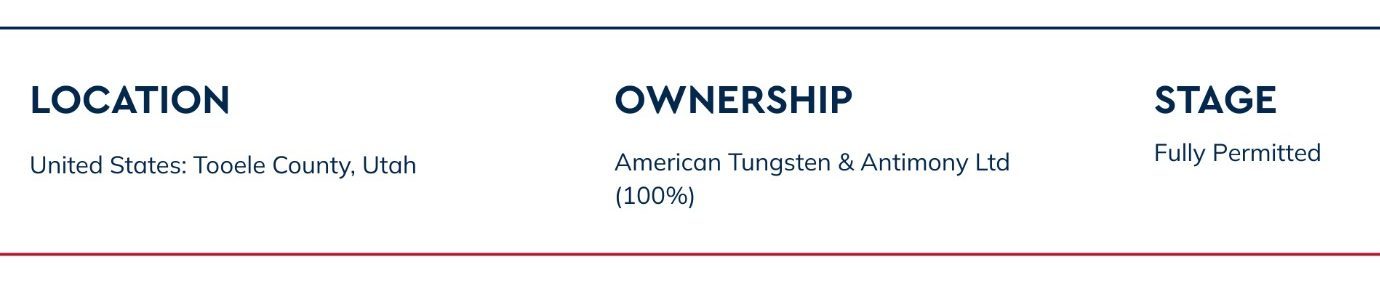
The acquisition includes the only fully permitted, operationally proven tungsten processing facility in Utah’s Clifton (Gold Hill) Mining District.
The Dutch Mountain Project comprises five claims and one private land parcel located within the historic Gold Hill (Clifton) Mining District, a region with a production history dating back to 1857. The acquisition includes the Fraction Lode, E.H.B. Lode and Star Dust mines, along with the fully permitted Dutch Mountain Processing Facility.
The Clifton District hosts numerous significant historical mines, including the Alvarado Mine and Reaper mines, which are largely privately owned. Despite their proven high-grade endowment, development across the district has been constrained for decades by the absence of a local, compliant processing facility.
The Dutch Mountain Tungsten Project and associated processing facility include the highly prospective Fraction Lode tungsten system, which was the last operating tungsten mine in the United States prior to ceasing production in 2017. The broader system also includes the E.H.B. Lode and Star Dust mines, where historical mining reported grades of up to 1.3% WO₃ and an implied grade of 2.2% WO₃ (based on production records), respectively. These historical grades are based on publicly available information and have not been verified by the Company in accordance with the JORC Code.
The Processing Facility
The Dutch Mountain Processing Facility comprises a simple gravity separation circuit optimised for coarse grained scheelite (tungsten), eliminating the need for complex flotation reagents to produce an initial concentrate. In 2017, the facility processed approximately 275 tonnes of tungsten concentrate from the Fraction Lode mine, validating the flowsheet under operating conditions.
Its location on private land provides a significant strategic advantage. Developing a new mill on federal land in the United States typically triggers the National Environmental Policy Act (NEPA), resulting in permitting timelines that can exceed seven years. As a State of Utah-permitted facility on private land, the Dutch Mountain mill avoids this extended federal process.
Key Deposits
Fraction Lode (Timm Mine)
A contact-metasomatic skarn formed at the Eocene intrusive contact with the Ochre Mountain Limestone. Historical mining (2017) targeted head grades of 1.7% WO3. The primary ore mineral is coarse-grained scheelite (CaWO4).
Star Dust Mine
Located nearby, mineralisation occurs in the basal layers of a limestone “roof pendant” suspended within the intrusive stock. This geometry suggests that significant mineralisation may occur in similar pendants or “blind” skarn bodies preserved at depth.
E.H.B. Lode
The nearby E.H.B. Lode serves as a proof of concept for the district’s high-grade potential. Sharing the same geological controls as Fraction Lode, it historically produced 2,374 tons of ore at an average grade of 1.3% WO3, confirming the exceptional potential of the Eocene contact zone.
