


Antimony Canyon
Antimony Canyon Antimony Project, Utah – Primed to be the USA’s first domestic producer and supplier of antimony

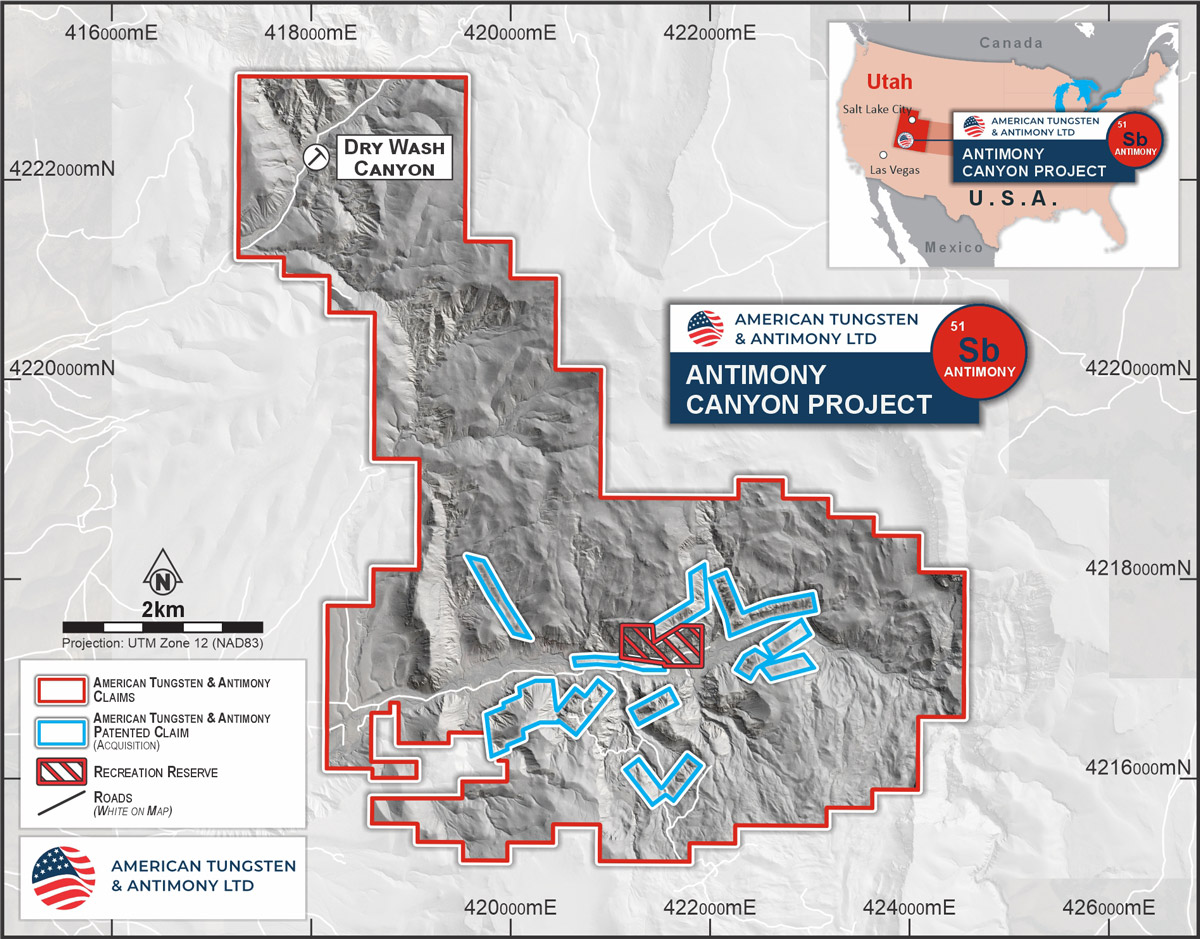
The company acquired 20 patented mining claims covering around 375 acres of the core deposit area. These are surrounded by more than 360 unpatented lode claims, offering potential for expansion. The project is situated in a mining-friendly region with year-round access and established infrastructure.
Antimony Canyon further strengthens ATAAs’ position in the U.S. critical minerals sector, as the United States has no domestic antimony production and is entirely reliant on imports. This strategic vulnerability has prompted strong federal initiatives to encourage the development of secure local supply chains.
The Patented Claim Advantage: A Fast-Track to Production
Our development strategy rests on owning 20 patented mining claims—one of our key competitive advantages.
What this means: Patented claims are private land. American Tungsten and Antimony own both the mineral and surface rights outright, removing the need for federal land leases and the delays that come with them.
Why it matters: Since the claims are privately owned, all permits are handled at the state level by the Utah Division of Oil, Gas and Mining (DOGM) rather than through lengthy federal procedures. This significantly speeds up the timelines for drilling and mine development.
Proven progress: In December 2025, we gained approval to start our first 24-pad drilling program on these claims. This achievement can take many years on public land and clearly shows the speed and certainty enabled by our patented claim position.
Geology
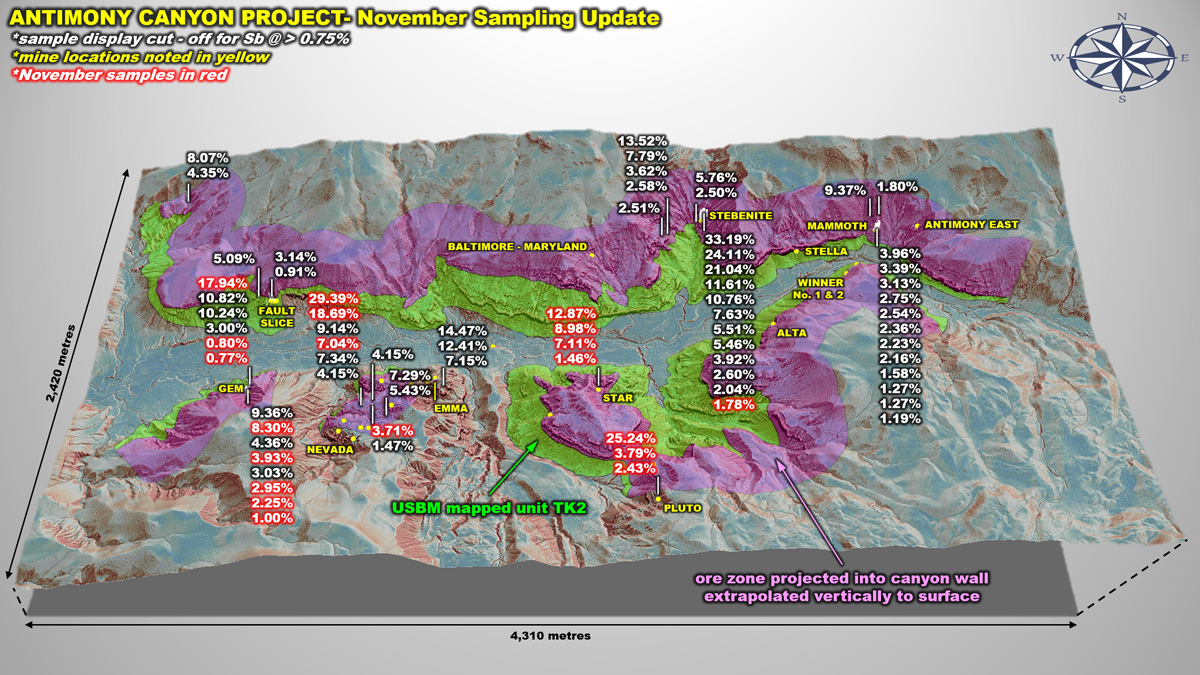
For decades, the Antimony Canyon district was misunderstood as a series of small, disconnected veins. Recent research by American Tungsten and Antimony (formerly Trigg Minerals) has significantly redefined the project’s potential using modern geological models.
AT4’s geologists have confirmed that the project is an extensive hydrothermal system. This type of system forms when hot, metal-rich fluids ascend from deep underground (magma sources) and deposit minerals over a wide area. This classification raises the project from a small-scale mine to a potential “district-scale” asset, comparable to major gold and copper deposits worldwide.
The key to the deposit is a specific rock layer called the “salt & pepper” tuff unit. This porous volcanic rock acts like a sponge or a chemical trap. As the metal-bearing fluids rise, they soak into this layer, depositing antimony across the mountain more horizontally than in narrow vertical cracks. This means the exploration and mining target is much wider and thicker than previously thought.
Recent exploration, including results from the CSAMT survey, has identified north-northwest-trending vertical faults, or “feeders,” that serve as conduits for metal to rise. The highest grades are found where these vertical feeders intersect with the horizontal “sponge” rock. Recent testing in these zones has yielded exceptional grades, such as 33.2% antimony, confirming that the system can carry very high metal concentrations.
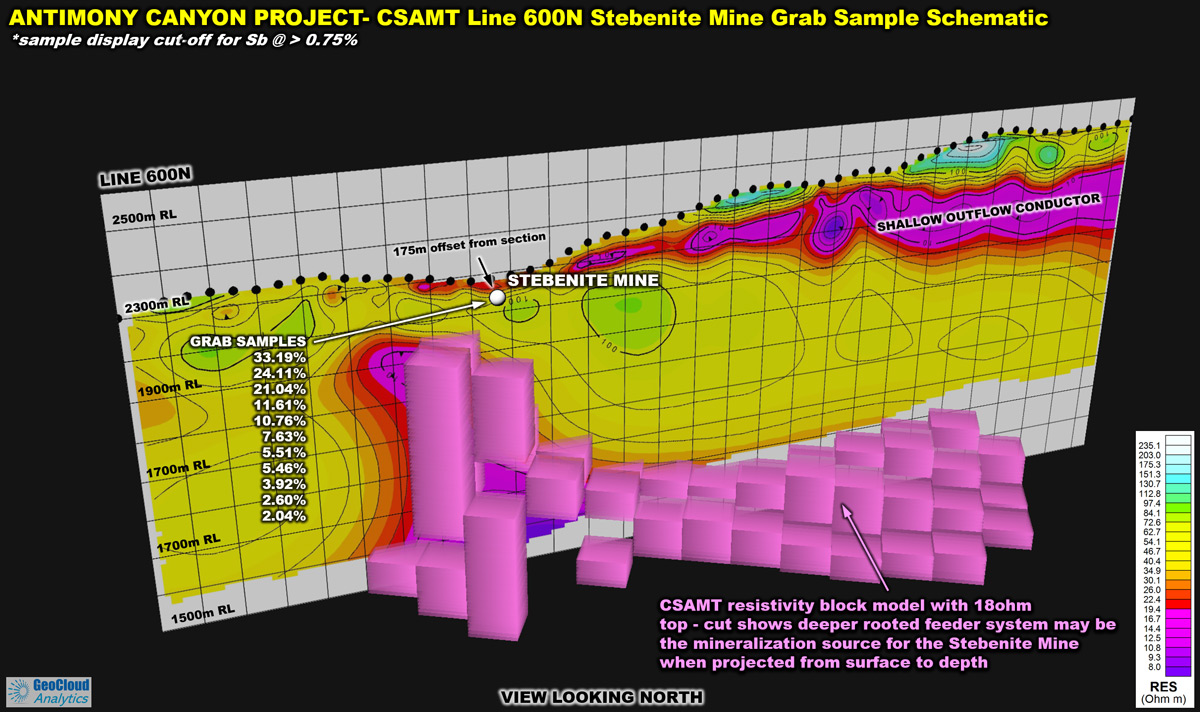
This new model demonstrates that mineralisation extends laterally along NNW-trending feeder systems, linking historic mines on the northern and southern flanks of Antimony Canyon—such as Emma and Stebinite—and continuing through to Dry Wash Canyon, located approximately 10 km to the north. Together, these areas form a single, extensive, laterally continuous mineralised system. Rather than targeting isolated, narrow veins, the Company can now focus on a broad, continuous body of mineralisation that may be well suited to modern bulk mining methods.
Exploration Target
We have established an initial Exploration Target for the patented claims of 6.1 to 6.9 million tonnes at grades ranging from 1.4% to 2.3% Sb, equating to 86,000 – 158,000 tonnes of contained metal*. This signifies a substantial potential supply for the American market.
*Note: An Exploration Target is conceptual in nature and requires further drilling to be classified as a Mineral Resource.